
How Can Lens Thickness Be Reduced in Cases of High Myopia?
People with high myopia generally require lenses that are thinner in the centre and thicker around the edges. Fortunately, several options can help reduce this thickness, resulting in eyeglasses that are lighter, more comfortable and more attractive.
The choice of frame is crucial. A small- or medium-sized frame that is properly centred in front of the eyes allows a smaller portion of the lens to be used. The closer the eyes are to the centre of each lens opening, the less the laboratory must decentre the lenses and the thinner their edges will be. Round or slightly oval shapes are often advantageous, while very large, angular or oversized frames tend to increase edge thickness.
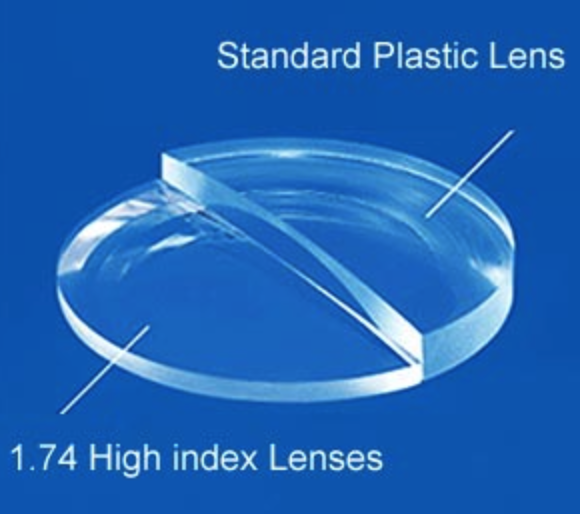
The choice of lens material also plays an important role. Depending on the prescription, a high-index lens in 1.60, 1.67 or 1.74 can significantly reduce thickness compared with a 1.50-index lens. The 2-4-6 rule can be applied here (see the previous article). However, the highest index is not automatically the best choice. Frame size, desired optical quality, weight, budget and sensitivity to chromatic aberrations must also be considered.
An aspheric or digitally optimized lens design can also improve the lens’s appearance and provide wider areas of clear vision. The distance between the lens and the eye should be as short as possible without allowing the eyelashes to touch the lenses. Proper frame adjustment therefore contributes to both comfort and visual quality.
Finally, a slightly thicker acetate frame can conceal part of the lens edge. For very high prescriptions, more specialized options, such as lenticular lenses, may also be considered.
The best strategy is to consider the prescription, pupillary distance, face shape, frame and lens type together. With expert guidance, the result can often be far more elegant than simply choosing the highest possible index.